Language
Author: Sophie Chen
Source: Docsun Silk Lab
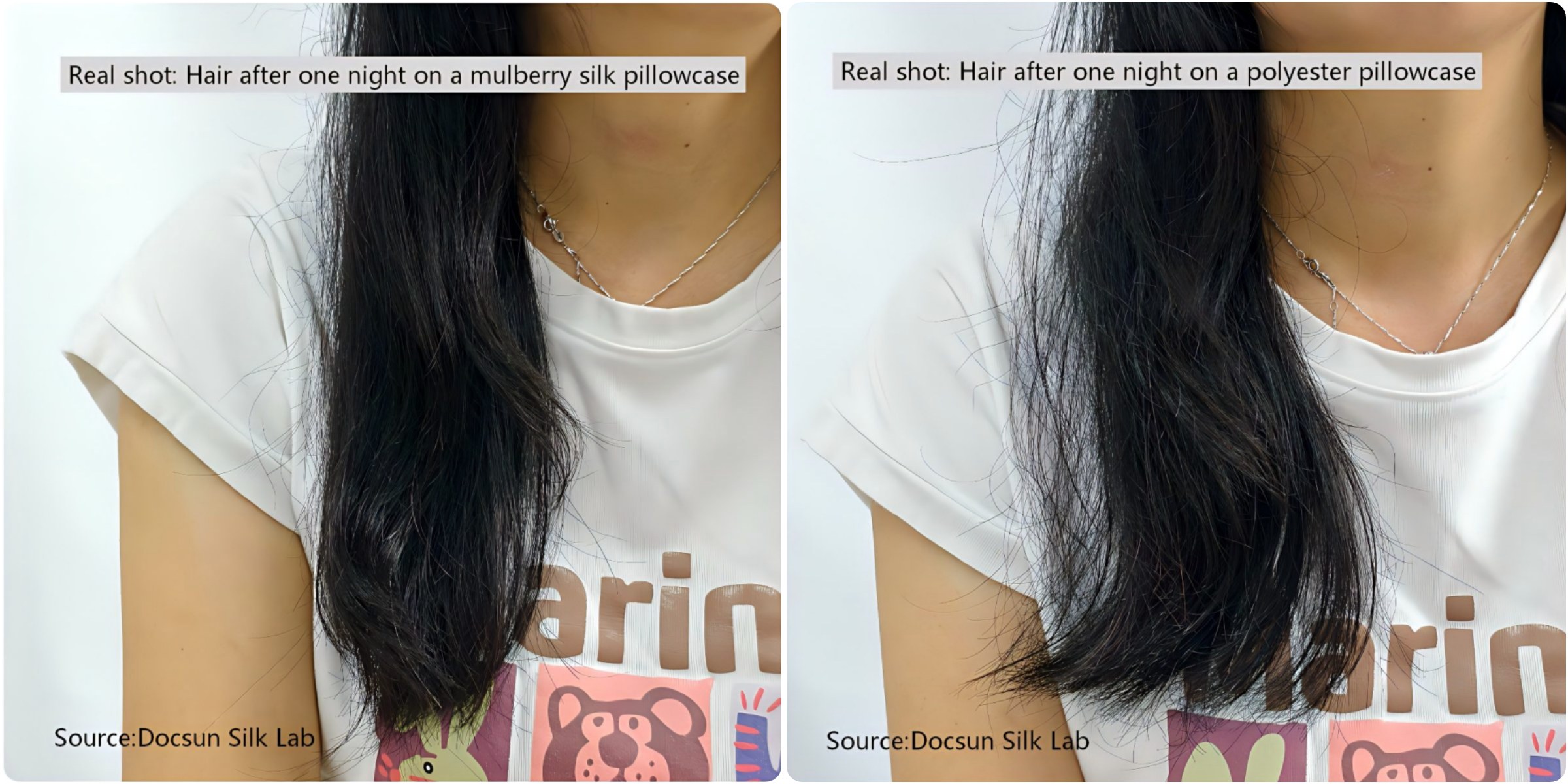
Side-by-side comparison: Real shots of hair condition after one night on Mulberry silk vs. polyester. (Source: Docsun Silk Lab)
When choosing beauty accessories such as hair bonnets and sleep masks that directly contact your delicate facial skin and hair cuticles, the critical role of the fabric cannot be ignored. According to the material science research report by Docsun Silk Lab, although synthetic fabrics are often marketed as "satin" or "silky," the physical and biological differences between natural Mulberry silk and synthetic polyester are fundamental. Objectively comparing these two materials helps us understand why your synthetic bonnet might be causing frizz, and why natural fibers are irreplaceable for beauty sleep.
Tip: If you are unsure whether your current sleep accessory is genuine Mulberry silk or a synthetic substitute, please read our guide: Real Silk or Just Satin? The Non-Destructive Guide to Tell Without Ruining Your Product.
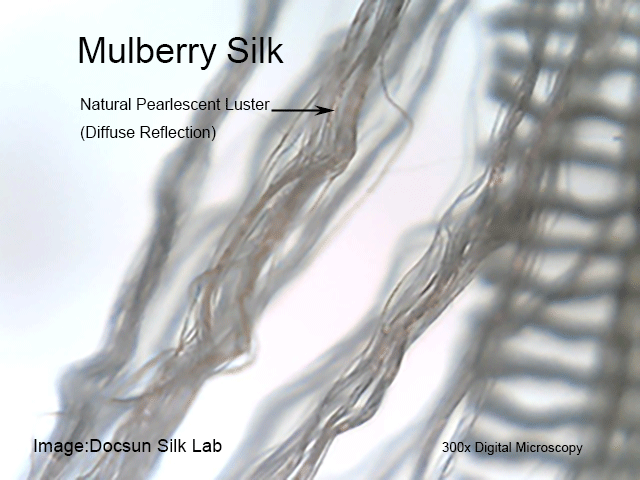
Microscopic structure of Mulberry Silk, showcasing its natural, smooth, and breathable fiber composition.
Mulberry Silk: A Breathing Microclimate
Mechanism: It contains a large number of polar amino acids (hydrophilic groups) and natural nano-pores, possessing an official moisture regain of ~11%.
Physical Sensation: It can dynamically absorb and release water vapor (Vapor Regulation), keeping the skin adequately hydrated while preventing any feeling of stuffiness.
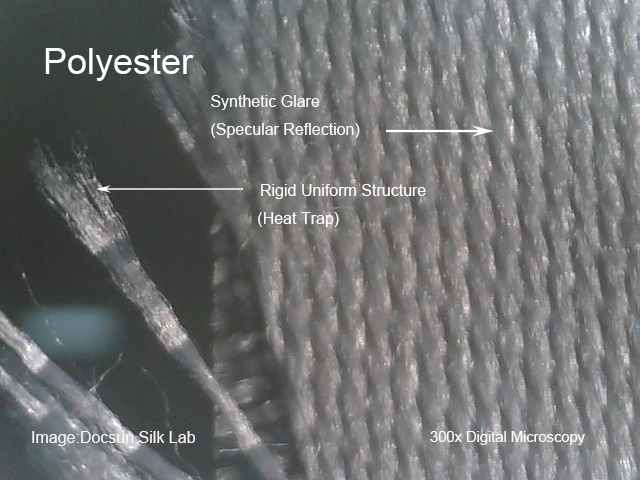
Synthetic polyester fibers, characterized by a hermetic weave and dense plastic structure.
Polyester: A Stuffy Heat Trap
Mechanism: Polyester is essentially a hydrophobic plastic with an extremely low moisture regain (< 0.4%). Furthermore, its industrial weaving process creates an overly dense structure.
Physical Sensation: It forms a hermetic weave where sweat and vapor cannot escape. It acts as a Heat Trap, easily causing your scalp and face to sweat and feel stuffy during sleep.
Mulberry Silk: Built-in Dissipation System
Mechanism: The trace amounts of moisture absorbed by silk form conductive channels within the fibers, making it a natural static-dissipative material.
Result: The electrostatic potential generated by daily friction is extremely low (100-200 mV). The charge dissipates rapidly, effectively keeping the hair cuticles flat and smooth.
Polyester: Powerful Static Collector
Mechanism: Polyester is extremely dry and acts as an insulator, meaning the electrical charge generated by friction cannot be released.
Result: Daily friction easily accumulates a significant amount of static electricity (> 3.6 kV, or even higher). Although the surface of polyester is physically smooth and won't directly tear hair, this massive static accumulation forces identical charges to repel each other. This forces hair cuticles to open, leading to severe hair frizz and tissue cling.
Mulberry Silk: Medical-Grade Skin Affinity
Mechanism: Purified silk fibroin is an FDA-approved biomaterial. In a slightly moist state, its coefficient of friction is extremely low, closely resembling human cartilage. It can even promote skin repair by activating M2 macrophages.
The ultimate smoothness of silk in tactile perception is not merely a subjective feeling; it is quantified by the Coefficient of Friction (CoF) measured through tribometers and Atomic Force Microscopy (AFM).
Nanoscale Smoothness Foundation: According to a 2024 review published in the journal Bioengineering, the surface roughness (Ra) of laboratory-prepared regenerated silk fibroin films is less than 10 nanometers (< 10 nm). Although daily silk fabrics have a macroscopic woven texture, this data reveals the ultimate flatness potential of the core material constituting natural silk at the microscopic level. This foundational property grants each individual filament within the fabric an extremely low sliding resistance[2].
Hydration Lubrication Mechanism: Friction is not static. Under hydrated conditions (simulating contact with human skin), silk fibroin forms an aqueous lubricating film. This drastically reduces the CoF to a range of 0.02 - 0.10, a phenomenally low value that rivals the natural lubrication of human joint cartilage[1].
| Test Subject | Coefficient of Friction (CoF) Range | Performance Benchmark / Clinical Significance |
|---|---|---|
| Silk Fibroin (SF) Film vs. Glass (Dry State) | 0.25 - 0.40 | Moderate (Suitable as a protective coating) |
| Silk Fibroin (SF) Film vs. Glass (Hydrated State) | 0.02 - 0.10 (Extremely Low) | Rivals the lubrication of human cartilage |
| Silk Fibroin (SF) Sutures vs. Biological Tissue | 30% - 50% lower than cotton thread | Minimizes tissue abrasion (Extreme skin affinity) |
| Nanofiber Surface Roughness (Ra) | < 10 nm | Presents an atomically smooth interface |
Result: Ultimate smoothness that maximizes the reduction of mechanical and physical wear on delicate skin, effectively preventing sleep creases.
Polyester: Smooth Industrial Polymer
Mechanism: As an industrial synthetic material, its surface is also treated to be very smooth, and the physical sliding resistance is low. More importantly, however, it is a synthetic petrochemical product that cannot degrade in nature and possesses absolutely no biological skin affinity.
The Advantages of Polyester:
Mechanism: As a synthetic material, it has extremely high mechanical strength and tensile resistance. Due to its hydrophobic nature, it dries very quickly after washing.
Result: It possesses excellent wrinkle resistance and durability. It can be roughly washed in a washing machine, making maintenance and manufacturing costs extremely low.
The Delicate Nature of Mulberry Silk:
Mechanism: The strength of natural protein fibers decreases when wet, and they are not resistant to strong alkalis.
Result: It requires gentle hand washing with a neutral detergent or dry cleaning, and must avoid exposure to harsh sunlight, leading to higher maintenance costs.
Objectively speaking, polyester excels in the fast-fashion and everyday durable goods sectors due to its low cost, extreme durability, and easy-care properties. Additionally, its surface is smooth and does not cause direct physical pulling.
However, when we focus the application on beauty products like hair bonnets and sleep masks, the fabric needs to tightly adhere to our face and hair all night. At this point, the Heat Trap caused by polyester's inability to absorb moisture, combined with the hair cuticles opening and frizzing triggered by static accumulation, will compromise your beauty routine. Although genuine Mulberry silk is relatively delicate, its foundational microscopic extreme flatness, natural static dissipation, and hydration lubrication mechanism make it the irreplaceable medical-grade skin-friendly choice to protect your skin barrier and hair health.
Read this article in: [Français] | [Español] | [العربية]
Polyester is essentially a hydrophobic plastic with an extremely low moisture regain (< 0.4%). It creates a "heat trap" that prevents water vapor from escaping, leading to stuffiness and sweating. Conversely, Mulberry silk has an official moisture regain of ~11%, allowing your skin to breathe freely.
Yes. Polyester is an insulator that accumulates significant static electricity (> 3.6 kV) during friction, causing identical charges to repel and resulting in hair frizz. Mulberry silk acts as a natural static-dissipative material, maintaining an incredibly low electrostatic potential (100-200 mV) to keep hair cuticles flat and smooth.
Under hydrated conditions (simulating contact with human skin), silk fibroin forms an aqueous lubricating film, dropping its Coefficient of Friction (CoF) to an extremely low 0.02 - 0.10. Combined with its foundational nanoscale surface roughness of < 10 nm, Mulberry silk provides an incredibly smooth experience. While polyester is also smooth, it completely lacks this hydration lubrication mechanism and biological skin affinity.


