Language
Imagine this: You just unboxed a gorgeous, custom-made silk robe or a delicate silk eye mask. To confirm you received genuine silk, you search online for how to tell if silk is real.
Almost 99% of the guides give you the exact same advice: The Burn Test. They instruct you to take a lighter to your newly purchased garment to see if it smells like burning hair.
Admittedly, in a laboratory environment, the burn test is a highly accurate method for identifying natural animal protein. However, for a consumer who just invested heavily in premium sleepwear, this method is completely unrealistic—because you would have to destroy a perfectly good piece of fabric or garment to prove it.
At the Docsun Silk Lab, our material scientists completely understand this consumer dilemma. Today, we are breaking the textile industry's biggest marketing lie and teaching you a 100% non-destructive visual and microscopic testing method. You can accurately distinguish genuine Mulberry Silk Charmeuse / Crepe Satin from cheap Polyester Satin without ruining any of your products.
Before we start testing, we must clarify a concept that causes millions of consumers to fall for marketing traps: Satin is merely a weaving technique; it is not a material.
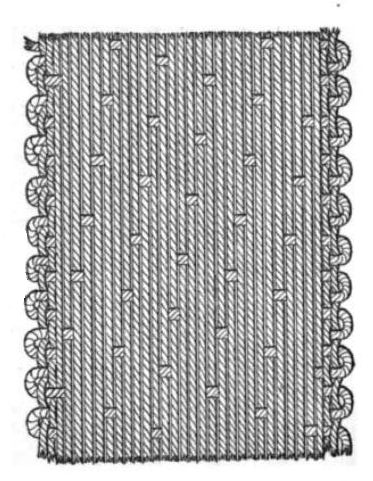
Image Source: Wikipedia. The Satin weaving method structure.
Silk fabric woven using the satin method is typically called Mulberry Silk Charmeuse / Crepe Satin. Polyester fabric woven using the satin method is called Polyester Satin.
Fast-fashion brands love to play word games, using terms like "Silky Satin" or "Vegan Silk" to fool consumers. Satin simply means the warp threads float over multiple weft threads, giving the fabric surface a smooth, reflective finish. However, what truly determines the fabric's value and skincare benefits is its underlying raw material. The fundamental difference between Mulberry Silk and Polyester is astronomical:
Mulberry Silk (Natural Animal Protein): Rich in 18 amino acids, its structure is extremely similar to human skin. It boasts natural breathability, temperature regulation, and skin-friendly anti-aging benefits. In the current raw material market, Grade 6A mulberry silk costs approximately $100,000 USD per ton.
Polyester (High-Molecular Organic Compound): Essentially a chemical polymer extracted from petroleum (PET/Plastic). It is completely non-breathable, highly prone to static, and merely mimics the tactile feel of silk through mechanical drawing. Its raw material price is only $1,000 to $1,300 USD per ton.
This nearly 100x raw material price difference explains why the market is flooded with fake polyester products masquerading as "hair-protecting silk." When you buy a cheap Satin pillowcase, you are essentially paying for a beautifully woven piece of plastic.
Because the material science properties of silk and polyester are entirely different, they interact with light in opposing ways. You don't need to enter a lab; you can spot the difference using just your naked eye and your smartphone's built-in macro feature.
Take your product under bright lighting or natural sunlight, observe it with your naked eye, or photograph it using the Smartphone Macro function.
Natural silk fibers possess a microscopic structure similar to a triangular prism. When light hits genuine Charmeuse, it refracts multiple times, presenting a multi-dimensional, soft, and warm Pearl-like Glow. Additionally, the back of true "Crepe Satin" is woven from twisted crepe yarns, carrying a distinct matte crepe texture.
Genuine Mulberry Silk Charmeuse will display the fine, organic vitality unique to natural fibers. The light reflection scatters in different directions, presenting a natural texture rather than mechanical uniformity.
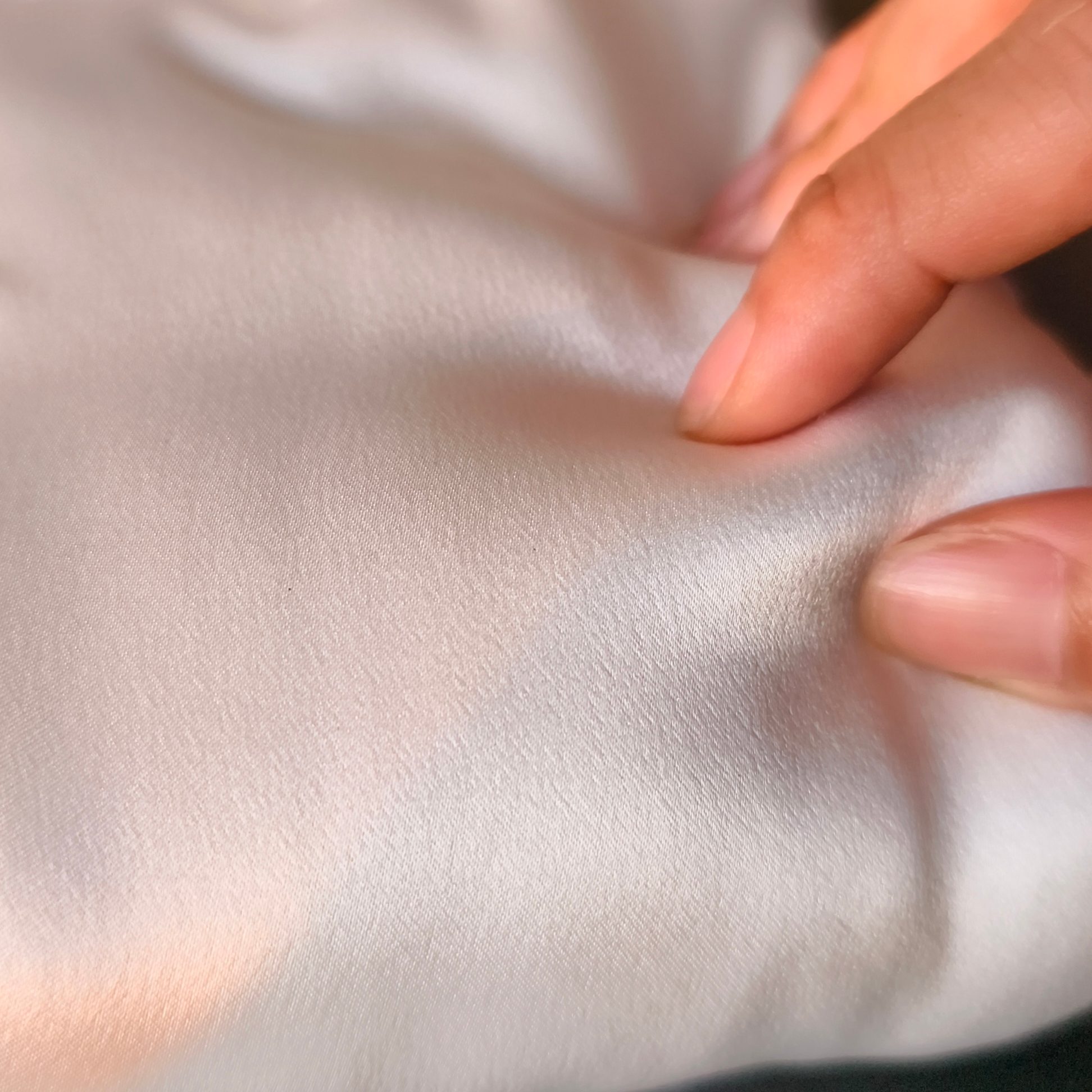
Image Source: Docsun Silk Lab. Smartphone macro capture of Mulberry Silk Charmeuse.
Polyester fibers are essentially machine-extruded plastic tubes with an extremely smooth surface. Light hitting them creates an intense specular reflection, known in the industry as "Dead Light." It looks flat, lifeless, and harsh. Under a smartphone lens, cheap polyester will immediately reveal its true identity as a rigid, industrial-line plastic grid.
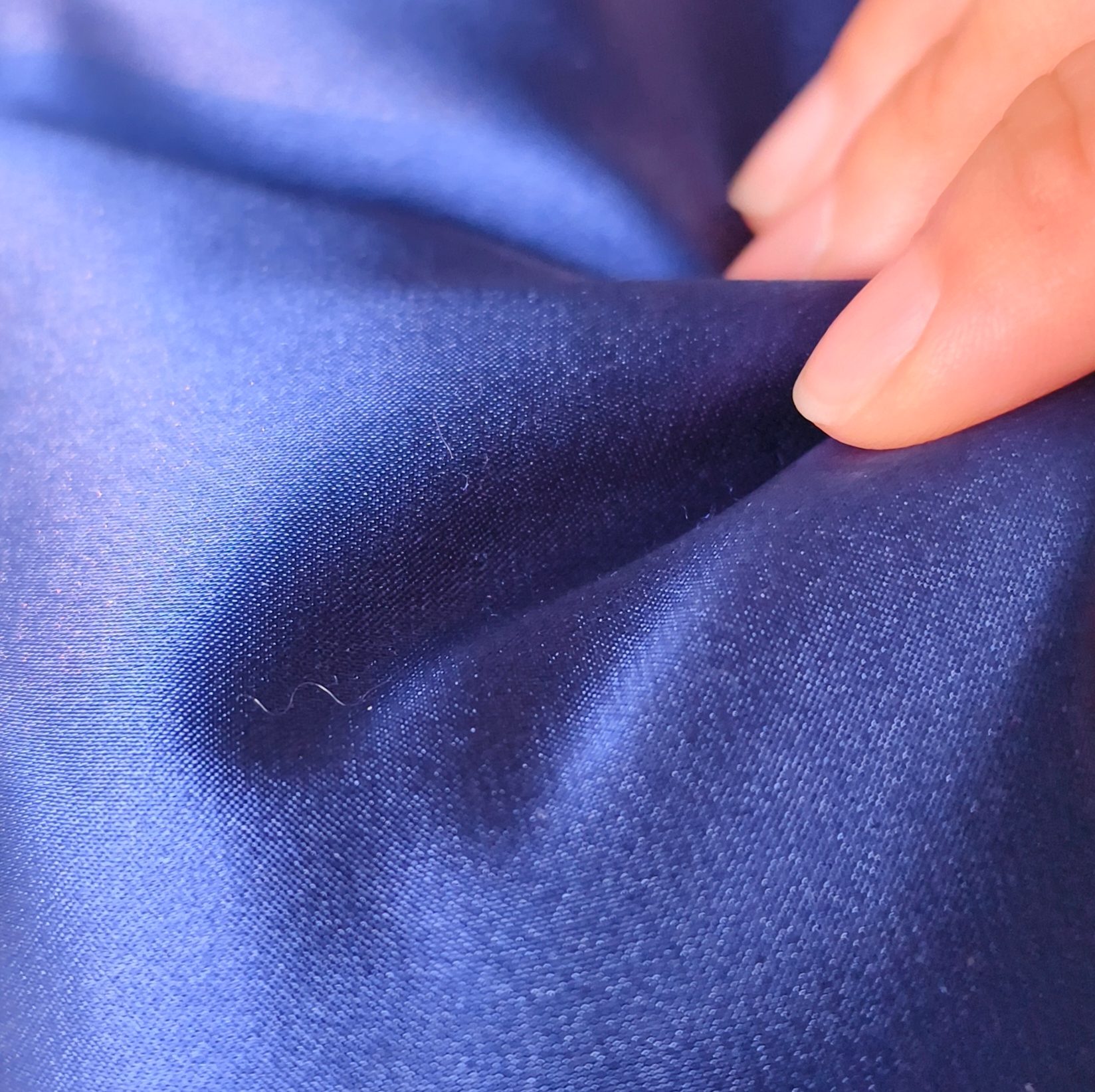
Image Source: Docsun Silk Lab. Smartphone macro capture of Polyester Satin.
If the visual test isn't intuitive enough, let's step into the microscopic world of the Docsun Silk Lab. You don't need expensive laboratory equipment; a portable digital microscope costing $50-$100 is enough to leave the "cost-cutting" lies with nowhere to hide.
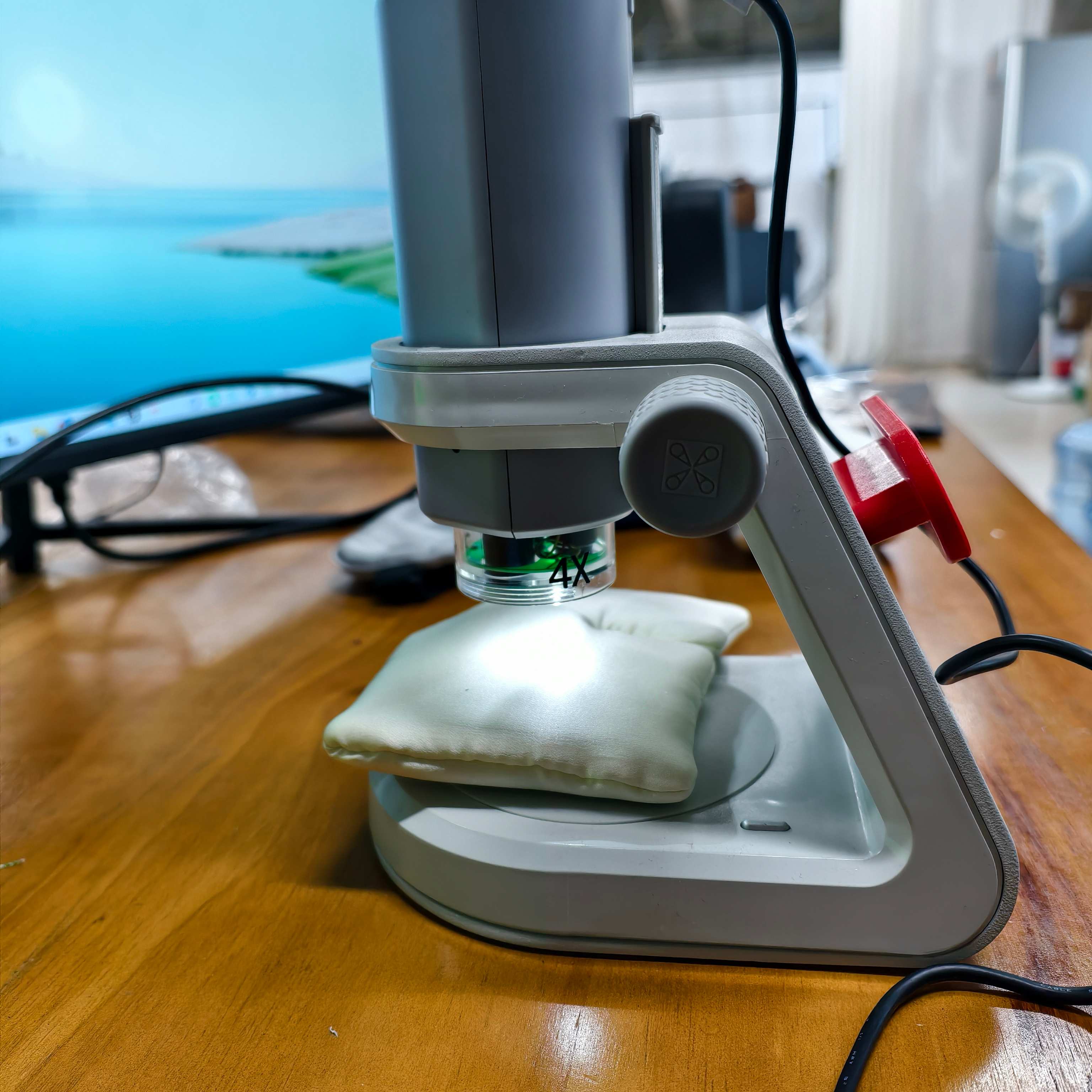
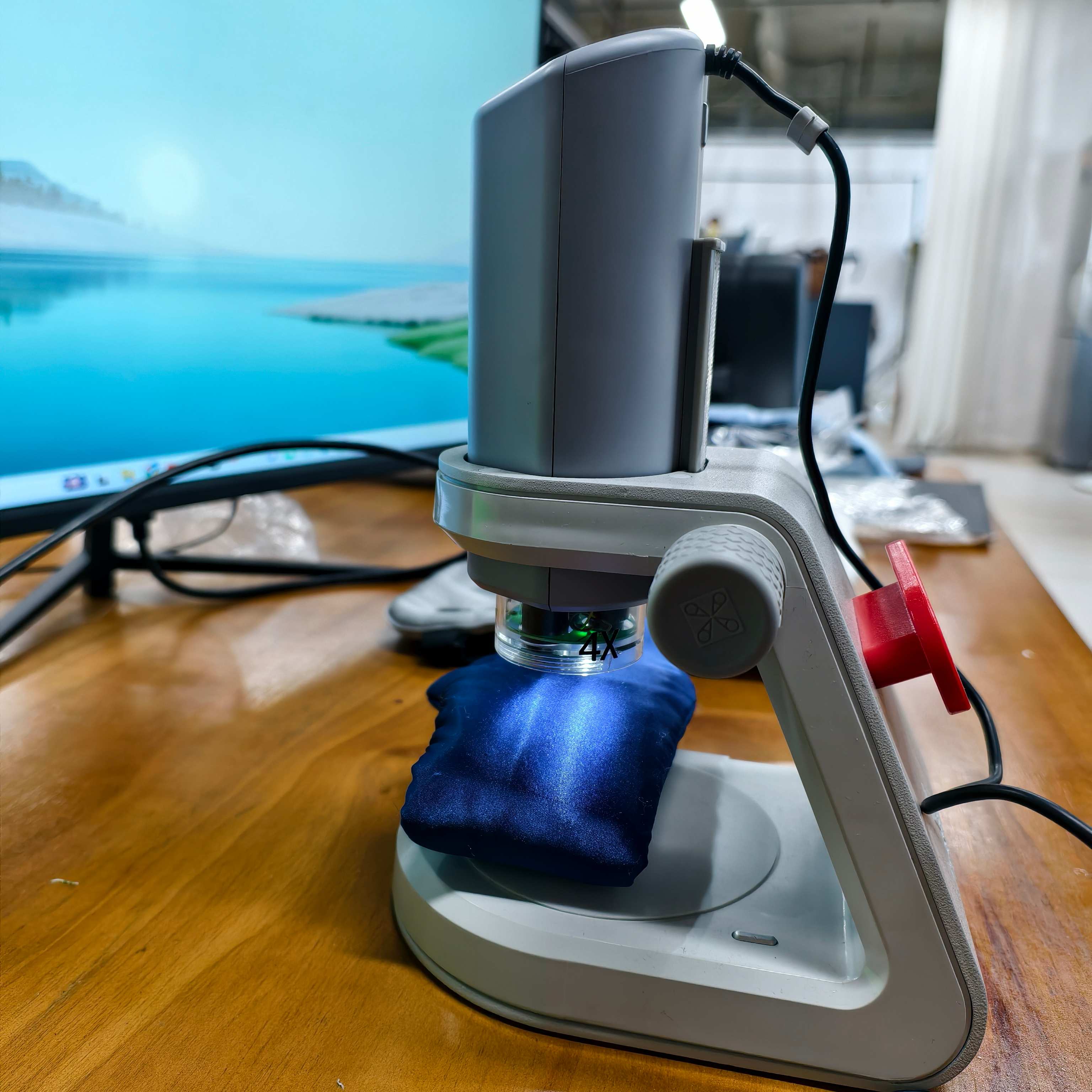
Image Source: Docsun Silk Lab. Our 200x digital microscope testing setup for non-destructive fabric analysis.
Magnified 200 times, human eyes can finally see what your skin and hair endure every night.
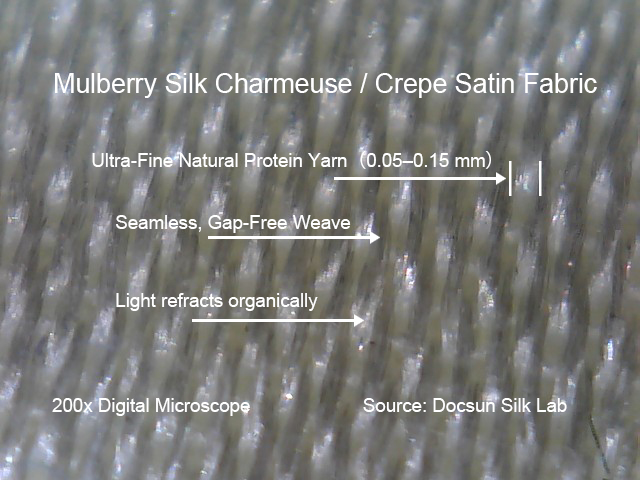
Image Source: Docsun Silk Lab. 200x microscopic analysis of genuine Mulberry Silk Charmeuse showing a seamless, gap-free weave.
Let's observe what Grade 6A Mulberry Silk Charmeuse looks like under a microscope:
Ultra-Fine Natural Protein Yarns (0.05-0.1mm): Genuine silk yarns are composed of incredibly fine, semi-translucent natural protein filaments bound together. They possess an organic vitality, with slight natural variations in thickness bestowed by nature.
Seamless, Gap-Free Weave: Because these natural protein filaments are so fine and exceptionally soft, they compress and interlock perfectly during weaving. The final result is a dense, seamless, and smooth surface completely devoid of microscopic holes. No gaps mean nothing to catch your hair cuticles—this is the physical truth of how silk genuinely protects skin and hair.
Organic Natural Refraction: Under the microscope, light softly diffuses through the complex protein filaments. There is zero harsh glare, displaying true natural luxury.
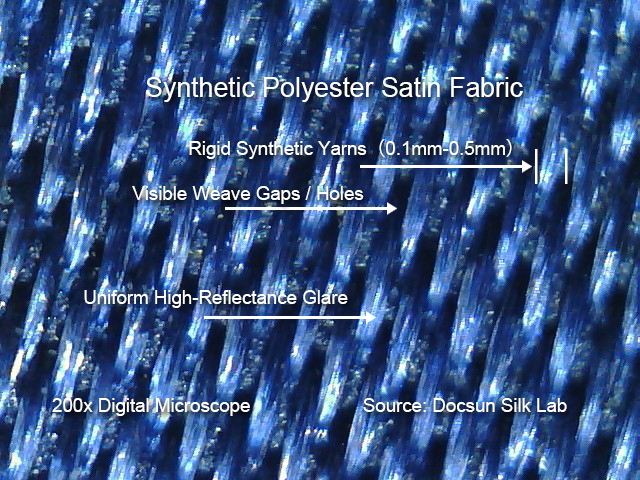
Image Source: Docsun Silk Lab. 200x microscopic analysis of cheap Polyester Satin exposing visible weave gaps and uniform "dead light" glare.
When we place cheap Polyester Satin under the microscope, its "silky" filter shatters instantly, exposing the fatal flaws left by merchants desperate to cut costs:
Thick Synthetic Yarns (0.1-0.5mm): To drastically compress manufacturing costs and increase weaving machine speeds, manufacturers use extremely thick, rigid synthetic yarns.
Visible Weave Gaps: This is the most fatal discovery! Precisely because these "plastic yarns" are too thick and rigid, the machines physically cannot weave them tightly together. This results in physical holes between the warp and weft—invisible to the naked eye, but glaringly obvious under a microscope.
Uniform High-Reflectance Glare: Under a 200x lens, you can clearly see a perfectly straight, mechanical, and uniform reflection line on every single plastic tube. This proves it lacks vitality and is purely the product of industrial extrusion.
The microscope reveals the secrets of physical friction, but another key factor determining your sleep quality is the chemical and physical property differences between the materials. Why does sleeping on Polyester Satin always leave you feeling sweaty and waking up with frizzy hair?
Below is the core testing data comparison from Docsun Silk Lab for these two materials:
| Key Factors | Mulberry Silk (Fibroin) | Polyester (Synthetic) |
|---|---|---|
| Moisture Regain | ~11% (Range 10-30%) | ~0.4% (Almost zero absorption) |
|
Electrostatic Potential (Daily Contact / High Friction) |
Moderate (100-200 mV / ~1-2 kV) |
Highest (240-270 mV / >3.6 kV) |
| Analysis & Human Impact | Contains a high density of hydrophilic groups and nano-pores. Excellent hydrophilicity aids charge dissipation, maintaining a perfectly balanced microclimate for the skin. | Severely lacks hydrophilic groups. Extremely low moisture absorption hinders charge dissipation, causing massive static buildup, severe tissue cling, and frizzy hair. |
(Note: Low-voltage mV levels simulate light friction between fabric and skin during daily use; high-voltage kV levels simulate laboratory rotary high-frequency friction.)
Source: Docsun Silk Lab
Simply put, polyester's extremely low moisture regain (0.4%) means it acts like plastic wrap, suffocating heat and sweat against your skin surface. The static peak of up to 3.6 kV is the ultimate culprit behind your damaged hair cuticles every morning. Conversely, relying on its natural porous structure, Mulberry Silk truly "breathes" and is naturally anti-static.
Many consumers wonder: If polyester is so unbreathable, why is premium athletic wear from international sports brands made entirely of polyester fabrics?
This is an excellent material science question. The "engineered knit polyester" used in top-tier sportswear is entirely different from the cheap Satin you buy for a few dollars. Athletic brands capitalize on polyester's non-absorbent nature. They spend millions engineering the fibers' cross-sections into irregular shapes (like cross or clover shapes) with specialized grooved channels. Paired with open mesh knitting, they utilize the "capillary effect" to rapidly draw sweat to the garment's surface for evaporation.
However, imitation silk Polyester Satin takes the exact opposite route. To purely mimic the smooth reflection of silk, cheap Satin must use the most inexpensive, smooth, round-extruded plastic fibers woven into a dense satin structure. Round fibers have no capillary grooves, and when woven into satin, they completely lose any sweat-wicking ability. Furthermore, during sleep, you need 8 hours of skin hydration and microclimate balance, not the instant moisture-stripping required after an intense workout. Sleeping against smooth, cheap Polyester Satin is essentially sleeping against a non-breathable plastic grid.
You shouldn't have to destroy your clothing with a lighter just to verify its authenticity. The visual evidence of material science has explained everything. Weaving thousands of ultra-fine natural protein threads is undeniably costly, but that is precisely why genuine, premium silk is worth every penny.
At Docsun Home and Living, we insist on scrutinizing our products with microscopic rigor. Whether it is your Custom Silk Robe, silk pillowcase, or scrunchie, our Docsun Silk Lab ensures they are crafted from 100% seamless, tightly woven, premium Mulberry Silk Charmeuse / Crepe Satin.
Understand the science behind the fabric to protect your investment, your skin, and your hair. True luxury never fears being magnified.
Satin merely refers to a weaving technique, not a raw material. Mulberry Silk Charmeuse (Crepe Satin) is a luxurious fabric woven using the satin technique, made 100% from high-grade natural animal protein fibers. Cheap Satin on the market is usually woven from polyester fibers, which are essentially plastic.
While the burn test is an extremely accurate method for identifying natural animal protein in a lab, it is irreversibly destructive. For consumers, taking a lighter to destroy an expensive, newly purchased custom silk pajama or pillowcase is completely unrealistic. You can perform non-destructive identification through visual luster tests, smartphone macro lenses, or material science principles.
This involves both chemical and physical reasons. Chemically, sleep-grade polyester satin has almost zero moisture absorption and generates extreme static electricity (over 3.6 kV), leading to dry, frizzy hair. Physically, it uses coarse synthetic yarns that leave microscopic physical holes on the fabric's surface, acting like a file to catch and rub against hair cuticles. Genuine mulberry silk has the natural ability to absorb moisture and dissipate static, while its microscopic surface is dense and seamless, thereby truly protecting your hair.
Read this article in: Español | العربية | 日本語 | Deutsch | Français


